Tuesday, May 14, 2019

Doris Day and the Director Who Knew Too Much


We just lost singer/actress/legend Doris Day.

In addition to everything else that's being written about her, she should also be remembered as the woman who embraced an AIDS-stricken Rock Hudson at a time when people thought that would kill you.

But what I really want to explore is how Alfred Hitchcock hobbled his remake of "The Man Who Knew Too Much" by casting Day as the titular man's wife (through no fault of hers).

She was a major motion picture star at the time so I see why he cast her, but in doing so, he watered down the suspense of the film.

Let me explain.

Here's the plot and (spoiler) the ending of both films: An American couple and their child is on vacation in some exotic foreign location. It is established early on that the woman has a latent talent that the husband made her give up in favor of being a homemaker.

Their child gets kidnapped and though the father spends the whole movie tracking down the kidnappers, it's the wife's latent talent that saves the day.

So far so good.

In Hitchcock's original version, the wife is an Olympic trap shooter. This brings an exciting ending when the kidnapper is holding her child at gunpoint on the roof of a building and the mother, on the street looking up in horror, steals a police officer's rifle and after a suspensefully long wait she lines up her shot ... and shoots the kidnapper dead.


Wow!

In the remake, Doris Day is a retired singer. At the end, the couple are in the home of the kidnappers while a big society party is going on. They know their child is in the house, so Doris sits at the piano, sings "Que Sera Sera," her signature song, and the little boy hears her voice and joins them in the living room.

How is that suspenseful?

Doris Day was many wonderful things. But she was not a badass.


Sunday, April 14, 2019

Film review: Shazam

This cover actually is a scene from the film.


Of all the recent DC movies, this is the closest to the spirit of the Richard Donner "Superman." Unlike the others this one expresses the notion that, hey, maybe it's fun to be a super hero.

And the movie stays pretty close to the source material, orphan Billy Batson  turns into an adult and is given the powers of six Greek gods when he says the name Shazam. Meanwhile, villain Sivana wants Billy's powers for himself.

Most of the movie is spent on the gee whiz aspect of Billy and his foster brother Freddy Freeman trying out the new super powers in mostly adolescent ways. Let's buy beer, let's go to the strip club. It's all a lot of fun for them until the villain shows up. It's light, funny and the writers have a love of the original material. (though if he has the wisdom of Solomon, he really shouldn't be doing this stuff.)

Some niggling things, for copyright reasons, they go through the whole movie without giving him a name. I was just waiting for someone to slip and call him "Captain Marvel," and they never do it. If Sony can lend Spider-Man to Disney, can't Marvel let DC use the name Captain Marvel if only once of twice, then call him "Cap" from then on like they did in the comics?

Also he now has lightning powers, where did that come from? Granted it looks cool, but is it even necessary?

That being said, after years of reading the comics, it's a thrill to actually watch Billy get struck by lightning and turn into Captain Marvel.

Spoilers:

And some crazy trivia, in the comics Freddy Freeman and Mary Batson remain teenagers when they say Shazam, why do they turn into adults here?

And I knew his foster family would turn into Marvels by the end of the film from years of reading the comics, but my 11 year old said they gave it away in the trailers anyway. Hollywood, please, leave us some surprises.

As a Philadelphian I enjoyed the scenery, but kind of rolled my eyes at the inaccurate police cars and subway station geography. (not to mention you can't buy beer in convenience stores.)

But it's still a lot of fun and except for a few grisly deaths, kid friendly.

Tuesday, April 9, 2019

JSA TPB: Ghost Stories


This trade paperback collects JSA #82-87

This is an old but not unwelcome story device: Building a story around the origin story of a villain. The best-known example is probably Alan Moore's "The Killing Joke."

This time it's the origin story of the Golden Age Hawkman villain The Gentleman Ghost. OK, I'm game, to the best of my knowledge he's never had an origin story, but there's an inherent flaw in giving this particular character an origin story. His whole gimmick wasn't him being a ghost, invisible except for a top hat and a monocle, his gimmick was it was never established if he actually were a ghost, or just a human criminal who was a really good illusionist. Each of his stories would end with Hawkman and Hawgirl scratching their heads; there was enough evidence left behind to go either way.

In this story longtime JSA writer Paul Levitz settles it for once and for all (spoiler): He's a ghost. On one hand it expands on his backstory, on the other hand, it ruins the whole character!

I had a couple other niggling problems, the Gentleman Ghost was a Hawkman villain, yet Hawkman isn't in this story. And after it's determined he is a genuine ghost, someone mentions they should really get the Spectre, and that's just brushed off. You know who else would be helpful? Dr. Fate!

So it starts with Power Girl having returned to the JSA HQ from her "Infinite Crisis" encounter with the Golden Age Superman and Lois Lane with Lois' secret journal. Ma Hunkle reads it to her because it's written in the long forgotten secret code of shorthand (this is a good touch).  Levitz goes back to his own "How Joe McCarthy broke up the JSA" story where we see the Earth 2 Batman and Superman having encounters with the Gentleman Ghost while the JSA is in retirement. Now Earth 2 retroactively doesn't exist at this point, and there never was a Golden Age Superman and Batman, and it shouldn't even be happening. When Ma Hunkle brings up the fact that DC can't follow the rules of its own reboots, PG gets all condescending and tells her in effect, "You're old and confused, stop asking so many questions about DC's inability to stick to the rules of a reboot," and it's like she's speaking directly to me.

(also, for some reason, one of Green Lantern's eyes is green. I missed when this started, and it's never explained here. Also, in this particular reboot, Jade is dead but that really didn't bother me because no DC character stays dead long.)


The story then moves to the present day where the JSA members are being haunted by the ghosts of their own personal lives, in which we learn Alan Scott once accidentally killed a guy. So that's cool. The Gentleman Ghost shows up, attacks again and again then disappears.

Everything comes to a head at London Tower where we get two armies of ghosts and the JSA in battle.

If you look past my small complaints it's a lot of fun, with some great art by George Perez, Rags Morales and Jerry Ordway. Luke Ross draws the Gentleman Ghost old-time flashback sequences and it's like reading Classics Illustrated, and I mean that in a good way.


Friday, March 29, 2019

I spoke too soon


Just when I thought Beetle Bailey was making gains, a big relapse. In today's strip, the general is upset that  Beetle (wearing a beret) drew an abstract picture of him. See, it's funny because you know how kids are today with their abstract art, amirite?


Tuesday, March 19, 2019

Credit where credit's due


I've given Beetle Bailey crap for being irrelevant, not understanding modern technology while insisting on making 'jokes' about it, and worst of all, not being funny.

Today, I laughed.


Sunday, March 17, 2019

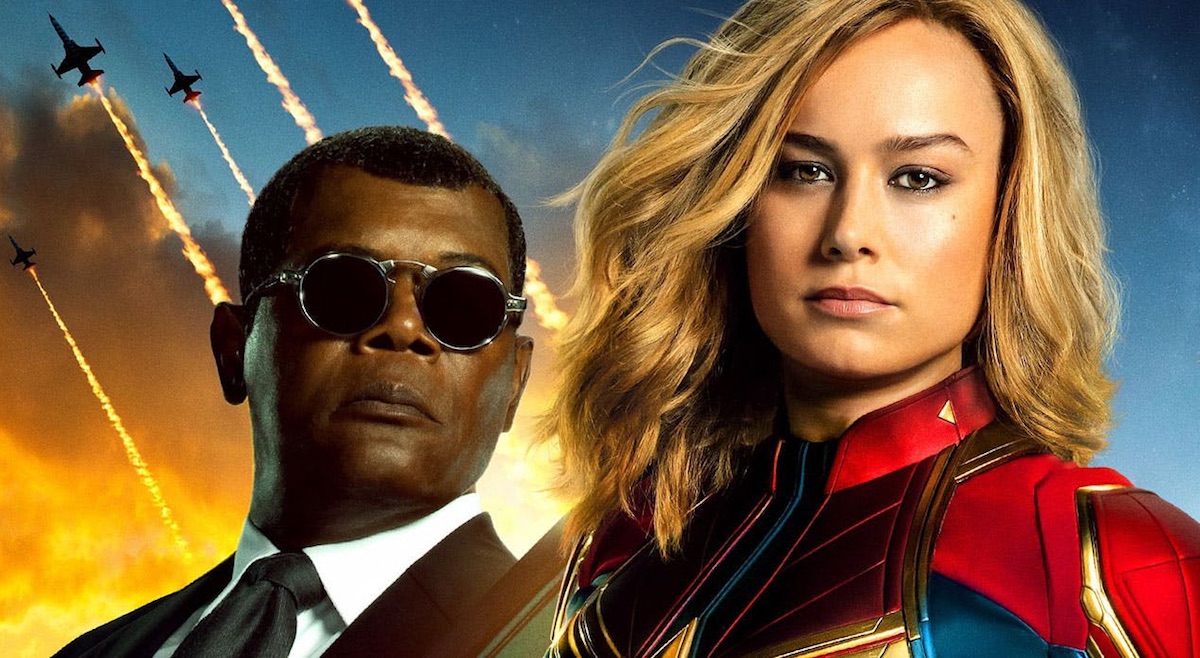
Film Review: Captain Marvel


Samuel L. Jackson helps an amnesiac badass.

Some minor spoilers...

Captain Marvel is another sturdy entry in the Marvel Cinematic Universe. Brie Larson is this charismatic, low-key superhero whose past and powers are slowly being revealed to her. We get great action sequences but, like Black Panther, there's a lot of backstory to get through.

What bothered me most is when you boil it down, it's just another hero-with-amnesia story. Amnesia hardly exists in the real world, yet we get movies where amnesia is the main plot point all the time. The character has the "now I remember who I am," moment in the last ten minutes or whenever it's most convenient for the plot.

In fact, Samuel L. Jackson already made a film where he's on a road trip with an amnesiac badass when he co-starred with Gena Davis in "The Long Kiss Goodnight." If you look at some of their plot twists, this is close to being a remake. And I knew Jackson was in the film, but I just thought he'd be making a cameo. Putting him in the entire film just brought more attention to its "Long Kiss Goodnight" parallels.

And since this film takes place in the 90s, we get a de-aged Nick Fury so he's not as much a badass as he is in the other Marvel films and this kind of takes the fun out of it. Speaking of the '90s, why is the film set in the '90s? We get a '90s soundtrack, a Blockbuster Video joke and a Radio Shack joke, and that's it. There was nothing in the film that demanded it be set that long ago, nor do they press it. It could have easily started with a title card that said, "Five years ago..."

I wasn't too keen on the end when she escapes the clutches of death. She pretty much wills herself out of it.

I was also bothered by Goose the cat. He plays a prominent part but it's never explained where he comes from exactly, or how they found him where they found him.

It's a good night at the movies, just don't think too much.

Sunday, March 10, 2019

Review: Action Comics #1000


The good:

The standout in this anniversary issue is "The Car," a story idea so simple it's amazing no one has thought about it before. We've seen hundreds of retcons, and reboots of the Superman mythology over the past 80 years, but this is the first story to ask, what exactly happened to that car Superman smashed on the cover of Action Comics #1?

Genius!

It could have been titled, "Action Comics #1: The Next Day." We find out what happened to the car, and by extension, what happened to the owner of the car who, as you remember, was kidnapping Lois Lane at the time he met up with Superman. The clever story is by Geoff Johns and Richard Donner, with exceptional art by Olivier Coipel.

The whole book is an homage to Superman, but only "The Car" is an homage to Action Comics.

They brought some creative icons back and they're always welcome: Neal Adams! Jim Steranko! Jose Garcia Lopez! Jerry Ordway! Marv Wolfman! Paul Levitz! Any comic book with only one of these creators is worth picking up ... and studying.

There's an amazing greatest hits package by Peter Tomasi and Patrick Gleason who give us a quick 80-year history through a series of full page recreations. Beautiful.

It ends with a Brian Michael Bendis, Jim Lee cliffhanger which introduces a whole new villain and storyline to be carried out in the future. It's intriguing for now, let's see where it goes.

The head scratchers:


There are two stories where Superman and Lex Luthor stand around and chat. Really, two? Lex Luthor bores me for the same reason the Joker does. He is the default villain. Make a Superman movie, use Luthor as the villain. Make another Superman movie, use Luthor as the villain, make another Superman movie, Luthor. Reboot the franchise: Use Luthor, reboot the franchise again? Luthor, yet again.


And he's not that good a villain.

The other disappointment was the Curt Swan chapter. Yeah, I get it, he was the Superman artist for 20 years, but the unpublished art they use doesn't even have Superman (just his narration, what a cheat!), and secondly, they must have been working with some really rough pencils because after it was digitized and colorized and photoshopped, very little of it looks like Curt Swan's work, same for the full page of Superman by Swan and inked by Kurt Shaffenberger, these two had extremely distinctive styles, all washed out by the time Photoshop got finished with them. I would have been happy with a single page of Superman flying from Swan and Murphy Anderson.

Do they drag out the Superman Day celebration (where something evil is afoot) every anniversary issue. It just seemed very familiar.

Though it's Action Comics' landmark issue, it's all about Superman. Where are the homages to the heroes of its back-up features.  We have two cameos of the Justice League en masse, but no Zatara? Where's the Human Target, Tex Thompson, The Vigilante, the Atom, Green Arrow? When comics had substantial page counts, Superman didn't carry Action alone. I loved those backup features. If I wanted to read just all Superman  stories, I'd get Superman, if I wanted some variety, I'd get Action.